

Use cases
Eight roles your Chief of Staff can fill, each written for a real job.
A role is a starting point, not a script. When real work needs it, your Chief of Staff creates an Agent into the role, with a sensible greeting, careful instructions and the tools that job usually needs. You then add your own knowledge, tone and rules until it sounds like your business.

Receptionist
Answers every call, handles common questions and routes callers to the right person.
A typical call
- 01Greets the caller warmly by your company name
- 02Understands why they are calling
- 03Answers common questions from your knowledge
- 04Takes a clear message or transfers to the right person
Suits
Clinics, agencies, offices and any business whose phone rings while the team is busy with the people in front of them.
Suggested tools
- 01Transfer to a person
- 02Capture leads
- 03End the call politely

Appointment booking
Books, moves and confirms appointments against your calendar.
A typical call
- 01Asks for the caller's name and the service they need
- 02Offers only times that are genuinely free
- 03Reads the booking back before confirming
- 04Sends a confirmation when messaging is connected
Suits
Salons, clinics, workshops, consultants and showrooms that live by their calendar.
Suggested tools
- 01Book appointments
- 02Transfer to a person
- 03End the call politely

Lead qualification
Asks the right questions, scores interest and hands warm leads to your team.
A typical call
- 01Learns what the caller is looking for
- 02Asks about timeline, budget range and who decides
- 03Captures the lead with a short summary
- 04Agrees a next step, such as a meeting with your team
Suits
Real estate, automotive, education and professional services that receive many enquiries of mixed intent.
Suggested tools
- 01Capture leads
- 02Book appointments
- 03Transfer to a person

Customer support
Resolves common issues from your help content and escalates the rest with full context.
A typical call
- 01Identifies the issue in the caller's words
- 02Walks through documented fixes one step at a time
- 03Checks whether the fix worked
- 04Escalates with full context when it is beyond the knowledge
Suits
Retailers, service providers and software companies with recurring questions and documented fixes.
Suggested tools
- 01Transfer to a person
- 02Capture leads
- 03End the call politely

Sales follow-up
Follows up on quotes and enquiries and books the next conversation.
A typical call
- 01Checks it is a good time to talk
- 02Reminds the person of their enquiry
- 03Answers questions from your knowledge
- 04Offers to book a meeting and respects any request to stop
Suits
Teams that send quotes or receive enquiries and want every one followed up promptly and politely.
Suggested tools
- 01Book appointments
- 02Capture leads
- 03End the call politely

Order status
Looks up orders and gives customers accurate delivery updates.
A typical call
- 01Asks for the order number
- 02Verifies one detail before sharing anything
- 03Shares only what the order lookup returns
- 04Transfers to your team for anything unusual
Suits
E-commerce, retail and distribution businesses whose customers mostly call to ask where their order is.
Suggested tools
- 01Look up orders
- 02Transfer to a person
- 03End the call politely

Collections reminder
Polite payment reminders with clear options, never pressure.
A typical call
- 01Confirms it is speaking with the account holder
- 02Explains the amount due and the ways to pay
- 03Never pressures and never takes card details
- 04Records any dispute for a person to review
Suits
Businesses that issue invoices, memberships or instalments and want reminders that protect the relationship.
Suggested tools
- 01Send a message
- 02Transfer to a person
- 03End the call politely

Logistics dispatch
Confirms delivery windows, addresses and driver handovers.
A typical call
- 01Confirms the recipient and the delivery address
- 02Agrees a suitable time window
- 03Notes access instructions for the driver
- 04Logs anything unconfirmed for the dispatch team
Suits
Delivery, moving and field service operations that need addresses and time windows confirmed.
Suggested tools
- 01Look up orders
- 02Send a message
- 03Transfer to a person








After every call
The work is written down before you ask
Whatever the use case, each call ends the same way: a summary you can read in ten seconds and a task for anything that needs a person.
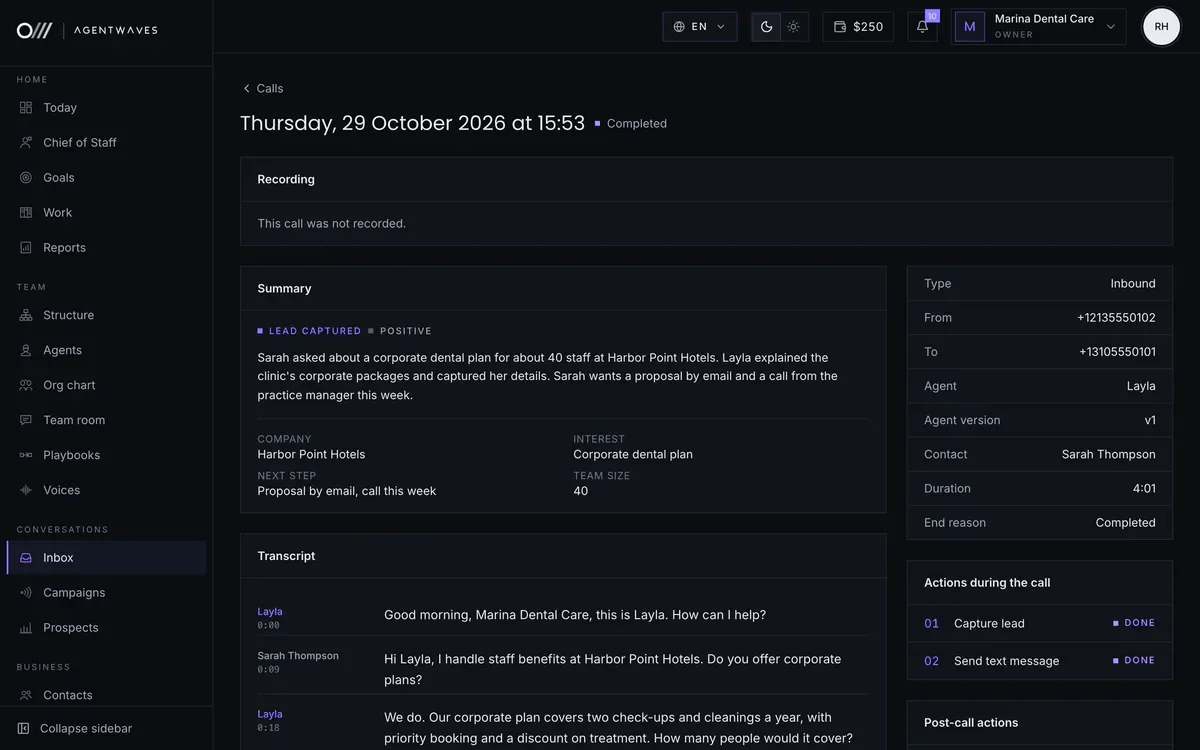
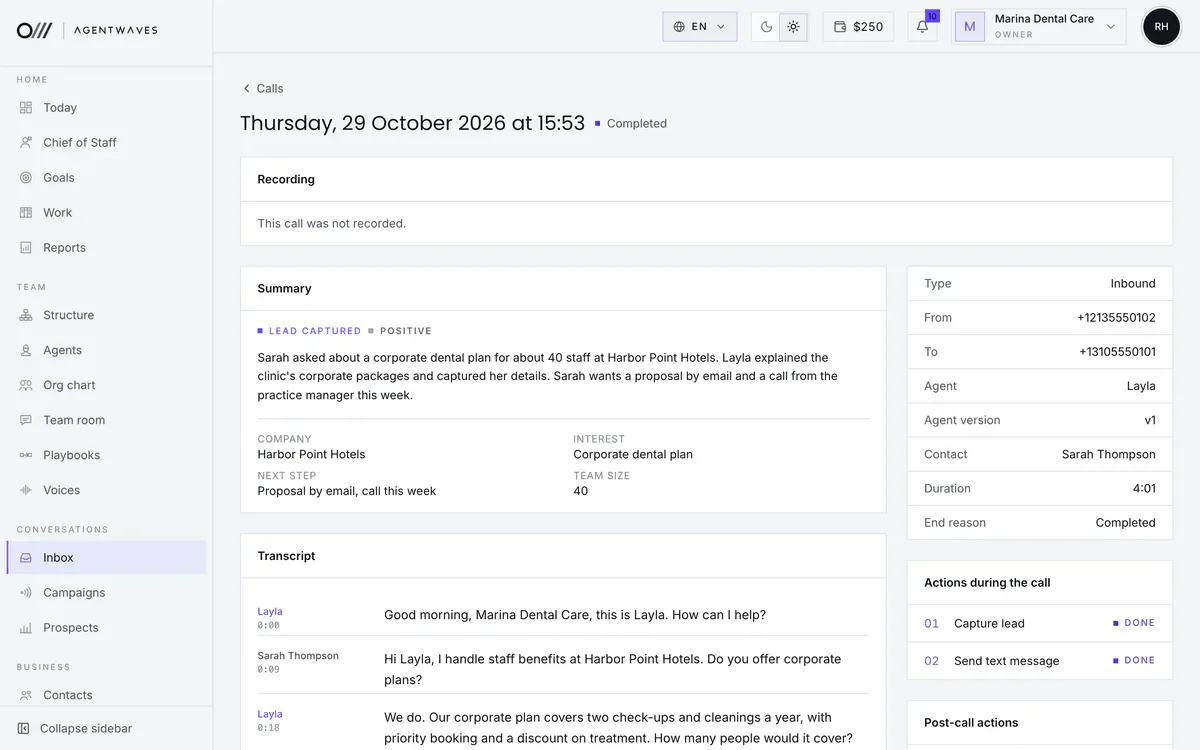
The call, summarised
What the caller wanted, what the Agent did and the details it collected, above the full transcript.
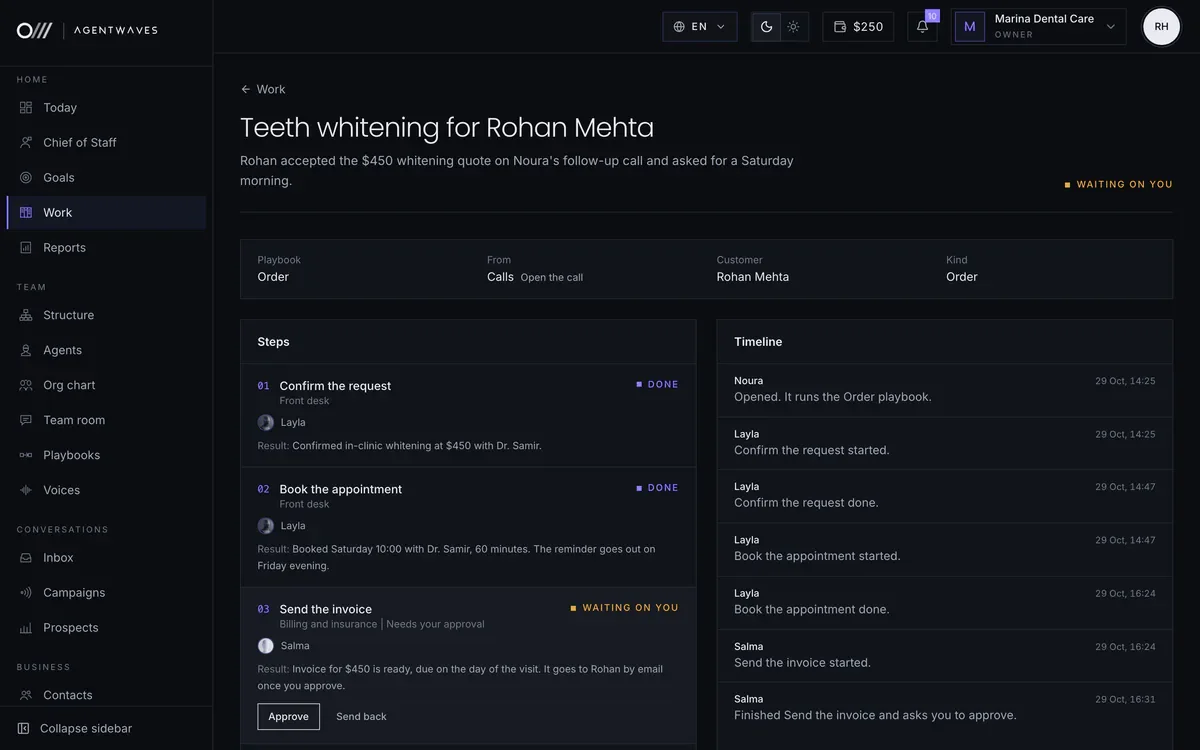
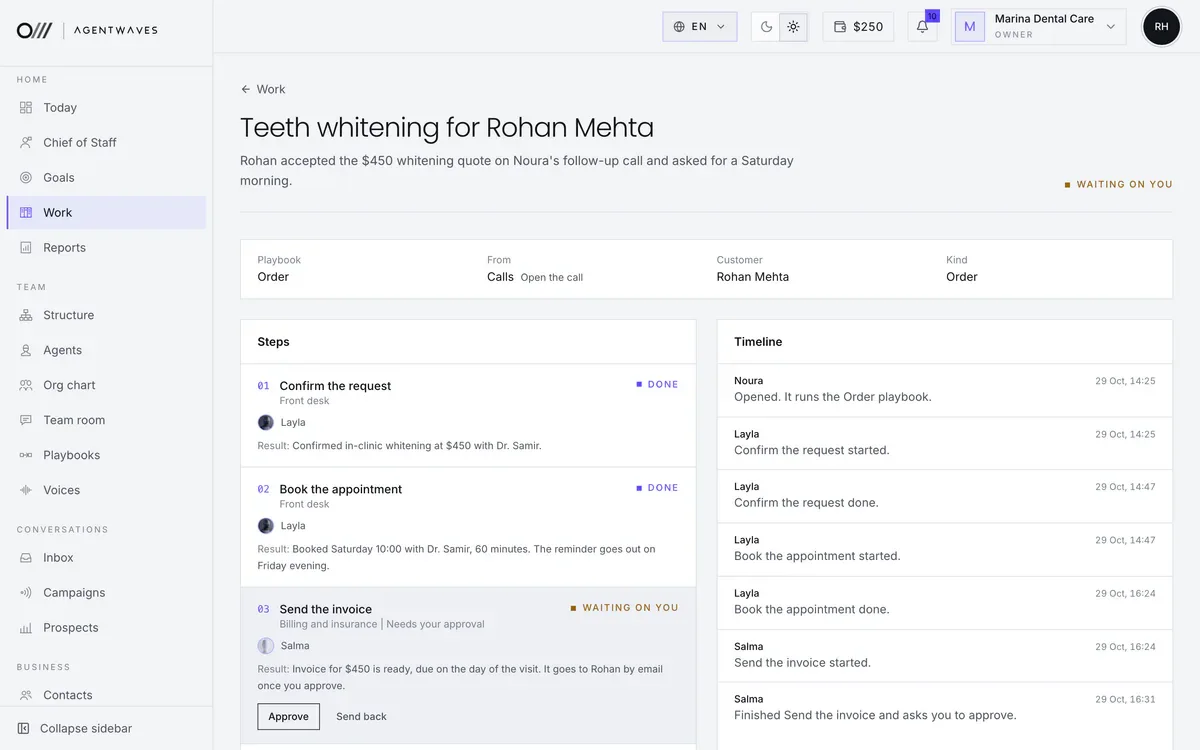
The follow-up, as a case
Promises made on the phone become a case that moves through your departments, with each step, its result and who did it on one timeline.
Sample workspace. People, numbers and figures are fictional.
Outbound calls
Who your Agent may call
Sales follow-up, collections reminders, logistics dispatch, campaigns and prospects all place calls. Every new Agent prepares each call and waits for your approval until you promote its role to Act.
- 01
People you may contact
Call customers, leads, delivery recipients and prospects your business is allowed to contact. Never bought or scraped lists.
- 02
Consent comes first
Respect every request to stop. Each contact in AgentWaves records where its consent came from, and anyone can opt out.
- 03
Local rules apply
Follow the calling and messaging rules of every country you call, including calling hours and do not call registers.
Accept the structure for your industry. Your Chief of Staff fills the roles.
During setup we propose departments and roles from your industry. Your Chief of Staff creates Agents into them when real work needs them, and you can change everything afterwards.